
Rear Window
Publication and premise
“Rear Window,” originally published as “It Had to Be Murder,” is a suspense and crime short story by American writer Cornell Woolrich. It first appeared in Dime Detective Magazine in 1942. The story was later reprinted under the title “Rear Window” and has appeared in collections; one collection marketed under that title includes four other stories as well. The work is a short story, not a novel or the screenplay of the later film, although its best-known title is now inseparable from Alfred Hitchcock’s adaptation.
The protagonist, Hal Jeffries, is confined to his New York apartment with a broken leg during a sweltering summer. With little to do and unable to move freely, he spends long hours looking through his rear window at the apartments across the way. From that limited vantage point, he watches fragments of his neighbors’ ordinary routines. One neighbor’s wife appears to have disappeared, and changes in the man’s behavior persuade Jeffries that a murder may have taken place. Yet a view from a window is not the same as complete knowledge: Jeffries must decide what his observations mean, whether his suspicions can be trusted, and what obligation follows if he believes a crime has occurred. As he pursues the question, detached watching becomes increasingly dangerous.
Form, themes, and atmosphere
Woolrich makes the restricted viewpoint the story’s central narrative device. Jeffries cannot leave his room, and readers are confined to what he can see and infer. The plot therefore turns on partial evidence: gestures, absences, glimpsed activity, and the gaps between them. Rather than relying on an elaborate police investigation, the story builds tension by making each new observation seem significant while leaving room for doubt. The heat, injury, and enclosed apartment intensify the sense of physical and psychological confinement. Across the narrow space outside, a familiar residential neighborhood becomes a stage on which everyday behavior may conceal a crime.
The story examines isolation, urban voyeurism, suspicion, and moral responsibility. The window offers Jeffries a way to pass the time, but it also exposes the uneasy distance between city dwellers who live close together without truly knowing one another. His attention shifts from curiosity to a conviction that someone may be in danger. That shift raises the story’s ethical question: when does watching cease to be harmless, and what should an observer do when he thinks he has witnessed a crime? Jeffries is not an all-knowing detective. His conclusions depend on incomplete evidence, so the suspense involves both the possibility that he is right and the possibility that he is misreading what he sees. Some discussion of the story has also noted a connection to H. G. Wells’s “Through a Window”; Woolrich’s distinctive achievement is to make the window itself the framework for suspense.
Legacy
The story became the basis for Hitchcock’s 1954 film Rear Window, starring James Stewart and Grace Kelly. The film is an adaptation rather than a literal reproduction, but it preserves the core situation of an immobilized observer who watches neighboring homes and suspects murder. Its success helped make Woolrich’s premise widely recognizable and secured the short story a lasting place in popular culture. The work remains notable for turning a commonplace apartment view into a source of danger and for making the reader share the protagonist’s restricted field of vision. It is a compact example of Woolrich’s ability to transform ordinary settings into tightly controlled suspense, and a landmark story in the tradition of crime fiction built around observation, uncertainty, and claustrophobia.
About the Author
Life and beginnings
Cornell Woolrich was born in New York City on December 4, 1903, and died there on September 25, 1968, at the age of 64. He attended Columbia University and began writing fiction while a student in the 1920s. His earliest books were not crime novels: they included Cover Charge (1926), Children of the Ritz (1927), Times Square (1929), A Young Man’s Heart (1930), The Time of Her Life (1931), and Manhattan Love Song (1932). These early works preceded his gradual turn toward suspense and crime fiction. His later reputation rests chiefly on his ability to place ordinary people in sudden, perilous circumstances and to make uncertainty itself a source of tension.
A major crime writer
From the 1930s onward, Woolrich wrote suspense novellas and short stories, and from the 1940s he became widely associated with crime fiction and the dark, fatalistic mode often called noir. The Bride Wore Black, published in 1940, was among his most important early suspense novels. It was followed by a sequence of influential crime books: The Black Curtain (1941), Black Alibi (1942), The Black Angel (1943), The Black Path of Fear (1944), and Rendezvous in Black (1948). Bibliographies differ in how they classify and count his output, but Woolrich wrote more than two dozen novels and over two hundred novellas and short stories. He also published under the pen names William Irish and George Hopley.
His fiction repeatedly turns familiar places and everyday routines into sources of danger. Characters may be isolated by circumstance, trapped by a mistaken judgment, or forced to act on evidence that is incomplete. That method is especially clear in “Rear Window,” first published in Dime Detective Magazine in 1942 under the title “It Had to Be Murder.” Its injured protagonist, confined to his apartment, watches the homes across the way and comes to suspect that a neighbor has killed his wife. Woolrich makes a restricted viewpoint do the work of an entire suspense mechanism: the reader sees only what the observer sees and must weigh the same fragments and uncertainties.
Adaptations and reputation
“Rear Window” became the basis for Alfred Hitchcock’s 1954 film of the same name, starring James Stewart and Grace Kelly. The film adapts rather than simply reproduces the story, but its central situation—the immobilized observer, the neighboring apartments, and the suspicion of murder—made Woolrich’s premise familiar to audiences around the world. Many of his other stories and novels were also adapted for film and television, and his work has been translated into numerous languages.
Woolrich’s later life was marked by unhappiness and seclusion; he spent his final years as a recluse in a Manhattan hotel. He died in New York City in 1968. He is remembered as one of the major American crime and suspense writers of the twentieth century, alongside such influential contemporaries as Raymond Chandler, Dashiell Hammett, and James M. Cain. His legacy lies not only in the number of adaptations his work inspired but also in his distinctive craft: enclosing characters within a narrow field of action, making ordinary surroundings feel threatening, and sustaining suspense through fear, isolation, and incomplete knowledge. “Rear Window” remains the clearest emblem of that achievement.
StoryFlow
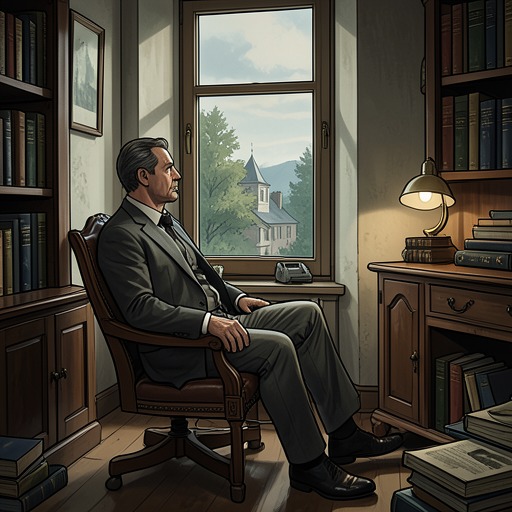
From Idleness to Murder Inquiry
This thread follows Hal Jeffries as enforced immobility turns casual window-watching into an investigation and finally a race for survival.
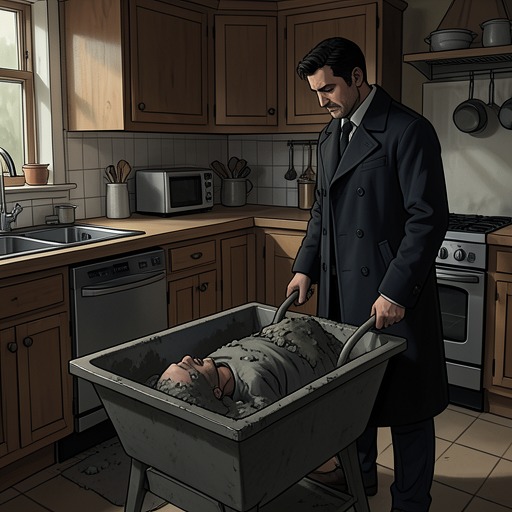
The Murder and Its Concealment
This reconstruction traces the crime, the improvised cover story, and the discovery of Anna Thorwald's hidden body.
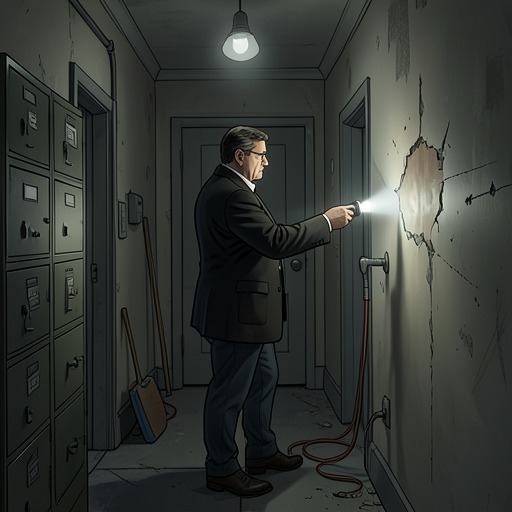
The Evidence Against Lars
This thread follows the clues as they move from ambiguous habits to a physical location and official confirmation.
